


The Meenakshi Amman Temple is one of India’s most visited temples and is a symbol of Tamil culture, devotion, and Dravidian architecture. Millions of devotees and tourists visit it every year to worship and admire its beauty.
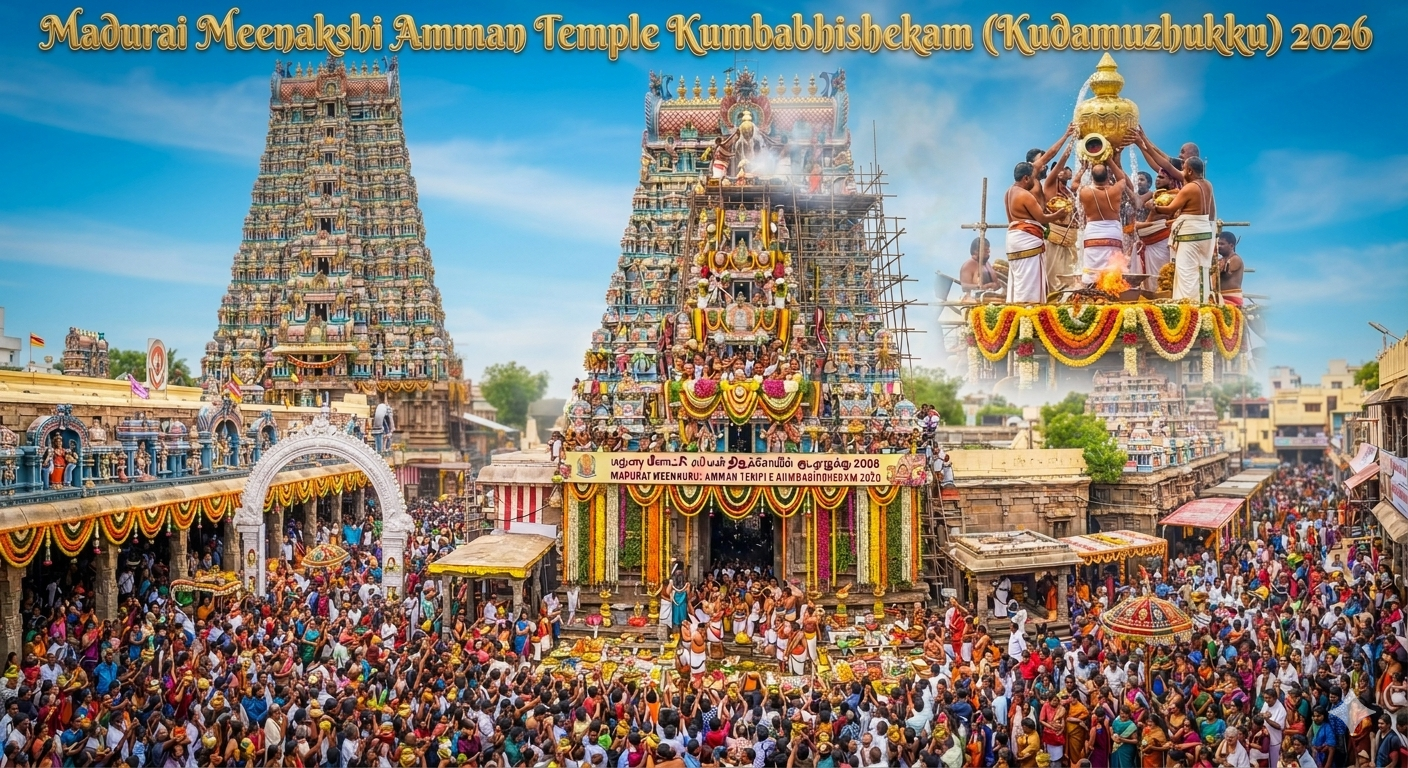
The Kumbabhishekam (Kudamuzhukku -2026) of the Meenakshi Sundareswarar Temple, Madurai is scheduled for:
Date: 17 September 2026 (Thursday)
Time (Muhurtham): 7:45 AM to 8:10 AM
This will be the temple’s first Kumbabhishekam in about 17 years, following extensive renovation and restoration work.
During the ceremony:
Holy water sanctified through Vedic rituals will be poured over the temple kalasams (the sacred finials on the temple towers).
Thousands of devotees from across India and abroad are expected to attend.
Special crowd management, security, and transport arrangements will be made by the temple administration and the Tamil Nadu government.
History of Madurai Meenakshi Amman Temple
The Madurai Meenakshi Amman Temple is one of the oldest and most important Hindu temples in India. It is dedicated to Goddess Meenakshi (an incarnation of Parvati) and Lord Sundareswarar (Shiva).
Ancient origin
Madurai has been a major cultural and religious center for over 2,000 years.
According to Hindu tradition, Lord Shiva blessed Madurai, making it a sacred city.
The temple is believed to stand on the site where Shiva married Meenakshi.
Architecture
The temple has 14 magnificent gopurams (gateway towers) decorated with thousands of colorful sculptures.
The Aayiram Kaal Mandapam (Thousand Pillar Hall) is famous for its beautifully carved stone pillars.
The Potramarai Kulam (Golden Lotus Tank) is an important sacred tank within the temple.
The Madurai Meenakshi Amman Temple was not built by a single person. It was constructed and expanded over many centuries by different rulers.
Early Pandya kings built the original temple more than 2,000 years ago.
After the temple was damaged during the invasion of 1311 CE, it was rebuilt and greatly expanded by the Madurai Nayak rulers.
King Viswanatha Nayak (16th century) began the major reconstruction.
Ariyanatha Mudaliar, his minister and military commander, supervised much of the construction.
Later, King Thirumalai Nayak added many important structures and beautified the temple.
So, the original builders were the Pandya kings, while Viswanatha Nayak, Ariyanatha Mudaliar, and Thirumalai Nayak were responsible for much of the magnificent temple seen today.

